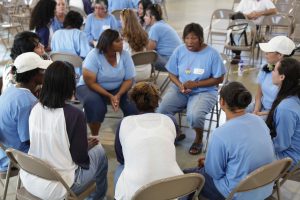
 (Peace Circle at the California Chowchilla Prison for Women)
Things go wrong in prison. That’s a given.
The wrongdoing ranges from the minor (tobacco contraband, for example) to the most serious (such as rape and murder). Prisons are overcrowded, hot, and volatile places, where intimidation and violence are the norm.
For egregious violations, prison officials will refer to ‘outside’ criminal justice investigation and prosecution. Most rule violations, however, are handled internally, following established Corrections policies and processes. These processes typically mirror traditional criminal justice processes including the establishment of facts and guilt; the imposition of sanctions or punishments; and established processes for inmate legal representation and the right to appeal. Prisons even have their own form of a prison within a prison: segregation.
With this post, I explore how a restorative prison could respond to wrongdoing. [Read more…]
 In the fall of 2017, I initiated a series of exploratory conversations with present and former Vermont Corrections leaders about developing a fully restorative prison facility. With their consultation and insight, I slowly and steadily designed a fellowship proposal that would have allowed me to work full-time within a single prison facility. Over the course of the 18-month fellowship, I would partner with facility staff and inmates to re-imagine their prison as a place of support, accountability, learning, and healing.
  Restorative Justice is clearly a movement whose time has arrived. Wherever you look, there are stories of new and creative applications of restorative principles, which are shaping and transforming the cultures of our schools, communities, and businesses. The sky is the limit.
 Why is it so difficult to effect change in correctional practices?